Google Ads vs Meta Ads: Which Is Best for Your Business?
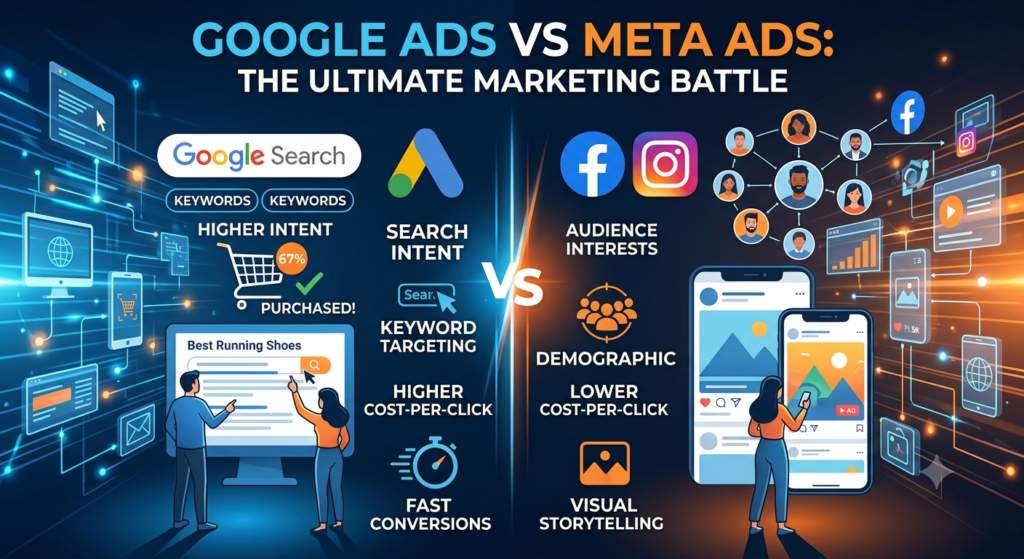
Google Ads vs Meta Ads is an important part of digital marketing. Choosing between Google Ads and Meta Ads (Facebook & Instagram) is one of the most critical decisions for a business. While both platforms offer massive global reach and sophisticated AI-driven campaign management, they operate on completely different principles.
Understanding the core differences between “google ads vs meta ads”—from search intent and audience targeting to costs, conversion rates, and ROI—will help you allocate your ad spend for maximum growth.
The Fundamental Difference: Intent vs. Interest
The primary distinction in the “google ads vs meta ads” debate comes down to Search Intent versus Social Discovery.
Google Ads (Captures Demand): Operates on high search intent. When a user types a specific query into Google, they are actively searching for a solution, service, or product. Your ad appears right when they are ready to act.
Meta Ads (Creates Demand): Operates on visual discovery and passive interest. Users scroll through Facebook feeds, Instagram Reels, and Stories to view content from friends and creators. Your ad interrupts their feed to introduce a product they might like based on their demographics and online behavior.
Google Ads Overview: High-Intent Lead Generation
Google Ads is the premier network for intent-based marketing. Whether a customer is searching on Google Search, YouTube, Google Maps, or browsing via Google Shopping, you are reaching users who are actively expressing a need.
Key Advantages of Google Ads
Higher Purchase Intent: Search visitors are actively looking for immediate answers, resulting in strong conversion rates.
Flexible Networks: Runs search text ads, shopping listings, YouTube video campaigns, and Performance Max across the entire Google ecosystem.
Local Dominance: Integrated with Google Maps to drive physical foot traffic and local service leads.
Primary Disadvantages of Google Ads
Higher Cost Per Click (CPC): Competitive keywords in industries like B2B SaaS, legal, and financial services carry significantly higher click costs.
Limited Demand Creation: You can only capture existing search volume. If no one is searching for your unique product name, Search campaigns will not generate clicks.
Meta Ads Overview: Visual Discovery and Scale
Meta Ads leverages deep data across Facebook, Instagram, Messenger, and WhatsApp. It relies on advanced algorithmic targeting to place eye-catching visual ads directly in front of ideal customer profiles.
Key Advantages of Meta Ads
Lower Initial CPC: Offers a lower average cost-per-click compared to competitive Google Search keywords.
Creative-Driven Scaling: Visual formats (Reels, Carousels, Video) allow you to showcase brand storytelling, product demonstrations, and user-generated content (UGC).
Lookalike & Advantage+ Targeting: Meta’s algorithms find users similar to your existing customer lists and top site visitors.
Primary Disadvantages of Meta Ads
Lower Immediate Intent: Users are browsing for entertainment, not shopping, requiring stronger creative hooks to drive immediate action.
Ad Fatigue: Audiences see the same ad creatives repeatedly, requiring frequent refreshing of video and image assets.
Google Ads vs Meta Ads: Side-by-Side Comparison
| Metric / Feature | Google Ads | Meta Ads (Facebook & Instagram) |
| Primary Mechanism | Search Intent (Inbound) | Audience Targeting (Outbound) |
| Core Ad Formats | Text Ads, Shopping, YouTube, Display | Video, Reels, Carousels, Single Image |
| Average Cost-Per-Click (CPC) | Higher ($2.50 – $5.50+ average) | Lower ($0.70 – $1.85 average) |
| Average Conversion Rate | Higher on Search (~3.5% – 7.0%) | Moderate (~0.9% – 2.5%) |
| Targeting Method | Keywords, Search Queries, Location | Demographics, Interests, Lookalikes |
| Best Campaign Objective | High-intent leads, local services, sales | Brand building, D2C products, remarketing |
How Ad Costs Compare
When analyzing google ads vs meta ads costs, raw CPC figures do not tell the entire story.
Google Ads: Higher CPC  --->  Higher Conversion Rate  --->  Competitive Cost Per Lead
Meta Ads:   Lower CPC   --->  Lower Conversion Rate   --->  Competitive Cost Per Lead
While Meta Ads generally provides cheaper clicks, Google Search traffic converts at a higher rate because searchers have immediate purchase intent. Consequently, both platforms can yield comparable overall Customer Acquisition Costs (CAC), depending on the industry and offer structure.
Which Platform Should You Choose?
Choose Google Ads If:
High Search Volume Exists: People are already searching for your specific products, services, or category keywords on Google.
You Offer Urgent Services: Immediate-need local industries like plumbers, locksmiths, emergency clinics, or specialized B2B software benefit from Google Search placement.
Your Primary Goal Is Immediate Conversions: You want to target buyers at the very bottom of the sales funnel who are ready to make a purchase decision.
Choose Meta Ads If:
Your Offer Is Highly Visual: Products in fashion, home decor, beauty, fitness, or consumer gadgets convert well through video ads and Instagram Reels.
You Are Launching an Innovative Product: If you are selling an entirely new product category that no one is searching for yet, Meta Ads lets you generate demand through visual storytelling.
You Want Cheaper Brand Reach: Meta offers lower Cost Per Mille (CPM / impression costs), making it suitable for broad brand awareness and creative audience building.
The Hybrid Strategy: Using Google Ads and Meta Ads Together
Instead of choosing only one platform, high-growth businesses scale by running a combined funnel strategy:
Top of Funnel (Demand Creation): Run Meta Ads (Instagram Reels and Video Ads) to introduce your brand, build visual awareness, and drive cold interest.
Bottom of Funnel (Demand Capture): Run Google Search Ads to capture high-intent users searching for your brand name or product terms after seeing your Meta Ads.
Cross-Platform Retargeting: Use Meta Ads to retarget website visitors who clicked your Google Search ads but left without buying, keeping your offer top-of-mind until they convert.